A brand new record just lately issued by way of Seattle-based Flexe, the biggest market of versatile on-demand warehousing in North The united states, supplied an in depth evaluate of the important thing elements influencing how shippers method and reconsider the place they want to dangle stock and the way lengthy of an area dedication is needed, or wanted.
The record, entitled “Q3 State of Spot Warehousing,” laid out 3 primary issues serving to shippers in making the ones choices: emptiness emerging with out bringing prices down; tariff-driven call for concentrated on the U.S.-Canada border; and a loosening in port markets, with inland hubs tightening.
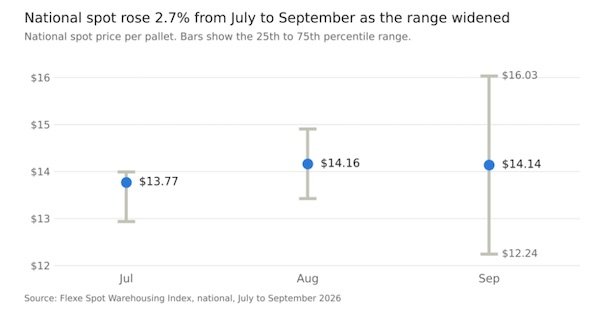
What’s extra, the record findings from the corporate’s Flexe Spot Warehousing Index, which made its debut in July as “the primary transaction-based benchmark for momentary warehousing within the U.S., which supplies shippers a shared reference level, for the primary time,” with the intention to plan round spot warehouse capability in the similar approach they plan round spot freight.
Notable findings from the index have been:
- Garage prices stay top regardless of slower hire expansion. Conventional warehouse hire expansion has slowed to at least one.3% once a year, according to information from CoStar, beneath September’s 3.7% CPI, however emerging working, stock, and transportation bills are conserving garage prices increased. Flexe anticipates spot and hire charges expanding in This autumn;
- Provide chains want better flexibility to control tariff uncertainty. Price lists are developing price pressures, in particular in import-dependent industries like aluminum. Shippers will have to construct agility into their provide chains and observe regional markets, particularly within the Northeast and within the Midwest, the place spot pricing greater in Q3; and
- Warehouse call for is moving from coastal to inland markets. Reshoring and greater direct-to-inland rail imports are using call for towards inland distribution hubs. Shippers will have to prioritize securing inland warehouse area as call for cools in primary coastal gateway markets.
In an interview with Logistics Control, Karl Siebrecht, Flexe co-founder and CEO, stated that this loose index is a benchmark device for provide chain planners to imagine other situations, if it is subsequent quarter or subsequent 12 months, for taking into account how a lot area will have to be leased below contract and likewise for the spot marketplace, similar to identical indices for the trucking and ocean shipment markets.
“The similar had now not been imaginable in warehousing so that’s what we made imaginable,” stated Siebrecht. “It is a transaction-based index that we’ve got constructed on best of seven-and-a-half years of bidding information in our market. Now we have been doing this for a dozen years, so we’ve got 1000s and 1000s of information issues. When an undertaking involves Flexe and says, ‘I want capability for a seasonal height, or I want capability for one thing that is occurring price lists, proper, or a strike within the port,’ they are going to come to Flexe with a necessity. In line with that scope of want, we cross to our large community of 3PL operators, and we solicit bids, so we get all kinds of bids for each unmarried alternative. We all know the low bid, the top bid, the profitable bid, and now we have taken all that information towards our years of information around the U.S. and Canada, and we put it on this index, yeah. It permits provide chain planners to imagine versatile on-demand warehousing as an actual choice.”
Taking a look at one of the most primary takeaways from Flexe’s Q3 record, Siebrecht famous that one in all them is principally a continuation of the “warehouse stagflation,” which has been noticed during the last two years, with the emptiness fee to hire a warehouse within the U.S. marketplace proceeding to moderately build up.
To that finish, he stated that vacancies have expanded, despite the fact that the growth fee has slowed, however, on the similar time, asking costs to hire a development have additionally long gone up.
“What you spot is an overly sticky pricing dynamic in long-term warehouse rentals, which is smart,” he stated. “If someone builds a development and fashions out money flows for twenty years according to asking hire [in the contract warehousing market] that they be expecting to get, if, by the point the development is going reside two years once they protected the financing and the marketplace has modified, you aren’t going to drop your hire fee by way of 20%—as a result of it is going to lock you in for five-plus years. In line with Co-Celebrity information, the common period of a leaser is over 5 years.”
The adaptation within the spot warehousing marketplace, he stated, is that the spot marketplace is a lot more aware of adjustments in provide and insist, with the 3rd quarter proceeding to peer emptiness charges within the lengthy marketplace build up and costs proceed to inch up.
“Issues are getting costlier for shippers and warehousing,” he stated. “Within the spot marketplace or the momentary versatile marketplace, we’re beginning to see capability inch up, even if capability stays rather to be had. The rationale we imagine the costs are ticking up are extra inflation-related…the enter prices to perform a warehouse are going up, as are such things as the rates of interest to hire your fork vehicles.”
Charges within the momentary marketplace, he added, are nonetheless typically sexy in comparison to the lengthy fee. For the 21 areas that the Flexe index covers, in 17 of them the spot fee remains to be beneath the asking fee, making them nonetheless fairly sexy.
Every other key metric within the index is call for depth by way of marketplace, with upper readings indicating tighter markets.
For the 3rd quarter, Flexe reported that call for depth dropped in 5 of six gateway markets, together with Seattle (34 to 24); Coastal LA (29 to twenty); and Savannah (48 to 38). Deman depth tightened in inland markets in 4 of 5 inland hubs, paced by way of a 5% achieve in Chicago, at round $11.50 in keeping with pallet, with freight having moved to rail.
“What we’re seeing [with demand intensity] is that a large number of this process is bypassing the ports and flowing inland,” stated Siebrecht. “We’re seeing greater call for in inland hubs and a softening of call for in coastal puts like Los Angeles and likewise Savannah.