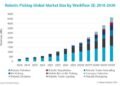
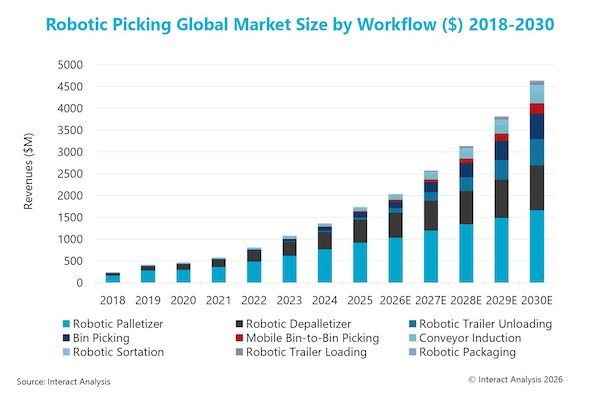
The robot selecting marketplace grew from $1.4 billion in 2024 to $1.7 billion in 2025, a 28% build up, and is forecast to achieve $4.6 billion via 2023, in keeping with a brand new file from Have interaction Research. That 22% reasonable annual expansion charge follows a duration of slower gross sales pushed via fewer greenfield trends and longer gross sales cycles.
The file defines robot selecting to incorporate the usage of desk bound robots with robot fingers to automate selecting and dealing with duties inside of warehouse operations, together with palletizing, depalletizing, and merchandise or case selecting. Robot palletizing and depalletizing stay the most important alternatives all the way through the forecast duration, and in combination made up the most important percentage of the marketplace in 2025, with each segments accounting for a mixed marketplace percentage of roughly 83%. Alternatively, the file suggests this may increasingly fall to roughly 58% via 2030, as expansion is outpaced via different segments, specifically bin-picking and robot trailer unloading.
“From a worth chain standpoint, we practice a number of rising tendencies. First, robotic OEMs are an increasing number of strengthening their in-house AI selecting device features. Over the long run, they’re more likely to transfer past supplying robotic {hardware} and be offering finish shoppers absolutely built-in robot selecting programs immediately,” stated Irene Zhang, senior analyst at Have interaction Research. “2d, warehouse automation device integrators also are increasing their features in AI-powered robot selecting, both thru strategic partnerships with AI device suppliers or thru natural construction. As device an increasing number of turns into a key differentiator, device integrators are searching for to construct more potent in-house experience to ship extra clever and built-in automation answers.”
Whilst larger buyer self assurance is using robot selecting expansion within the brief time period, long-term enlargement on this phase is basically pushed via the expansion of extra built-in bin-picking answers, the file says. Because the generation turns into extra commercially viable, it’s anticipated to seize an expanding percentage of the marketplace. The workflow generated $125 million in gross sales in 2025, and that is projected to upward push to $577 million via 2030, representing a mean annual expansion charge of roughly 36%. The sturdy expansion charge for bin-picking answers seems to be related to the expanding availability of tightly built-in answers that simplify deployment, fortify self assurance and cut back uncertainty for purchasers taking into account robot selecting answers. On account of this expansion, bin-picking is predicted to be the important thing contributor to the whole luck of the robot selecting marketplace.
Each robot and warehouse automation OEMs are demonstrating a rising passion in increasing into belief and motion device. For robot OEMs, this represents the advance of their very own AI fashions on this box, both in-house or thru partnerships with firms comparable to NVIDIA. Warehouse automation device suppliers are an increasing number of searching for to combine robot selecting natively into their present answers.
The file additionally signifies that, in addition to robot and warehouse automation OEMs taking a look to amplify into belief and motion device, belief and motion device consultants are an increasing number of shifting towards device integration. Some firms are already providing mixed robotics and device answers and getting into into device integration, suggesting companies inside of robot selecting see sturdy income doable around the price chain.