Provide chain organizations are making an investment in synthetic intelligence (AI) and automation sooner than they’re development the safe, built-in knowledge construction wanted to provide those new programs, in step with new GS1 US find out about, The Provide Chain Readiness Hole. In keeping with the survey effects, whilst just about 60% of surveyed organizations have automatic maximum provide chain processes or carried out AI and system finding out applied sciences, most effective 38% document centralized techniques that gather and combine knowledge in genuine time. In the meantime, 32% nonetheless depend on manually integrating knowledge from more than one assets, growing bottlenecks that restrict visibility, gradual decision-making and impede enlargement.
The findings level to a broader chance: Generation investments can stall when the underlying knowledge basis is fragmented. Even though organizations proceed to put money into innovation, 41% say they are able to effectively pilot new applied sciences however battle to scale them throughout their operations. Information fragmentation is without doubt one of the most vital limitations to innovation, cited by means of 62% of respondents, 2nd most effective to loss of investment (63%).
Performed by means of Redpoint for GS1 US, the analysis surveyed 500 provide chain pros throughout grocery retail, foodservice, healthcare, attire, basic products and client packaged items. Adulthood tiers had been derived from more than one operational signs moderately than respondents’ direct exams of their very own adulthood.
The analysis additionally supplies a benchmark for organizations to evaluate their provide chain readiness and establish the features had to transfer from remoted generation investments to enterprise-wide scale. In line with features throughout knowledge integration, governance, automation, collaboration and criteria adoption, respondents had been grouped into 3 adulthood tiers: 20% prime adulthood, 72% medium adulthood and eight% low adulthood.
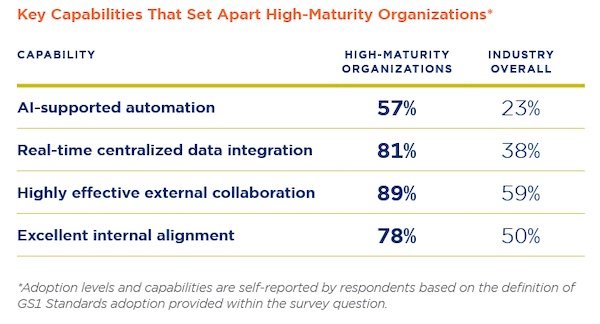
Top-maturity organizations distinguish themselves in different key spaces:
- Information integration: 81% document centralized, real-time knowledge integration, when put next with 38% of all respondents.
- Information governance: 85% document a transparent and actively finished governance technique, when put next with simply 13% of low-maturity organizations.
- Spouse collaboration: 89% document extremely efficient exterior collaboration, when put next with 59% of the total pattern.
- Inner alignment: 78% document sturdy inner alignment, when put next with 50% of all respondents.
Those features also are related to more potent industry results, reinforcing that knowledge readiness is a industry crucial, now not merely an operational worry. Top-maturity organizations are much more likely to document more straightforward regulatory compliance (60%), lowered prices (52%) and sooner time to marketplace (46%).
“Organizations nowadays face expanding force to navigate regulatory necessities, provide chain disruptions and abruptly evolving buyer expectancies,” stated Gena Morgan, vice chairman of world criteria, GS1 US. “This analysis displays that generation on my own isn’t sufficient. True provide chain readiness calls for sturdy buying and selling spouse collaboration, depended on knowledge and standards-based interoperability. Organizations that put money into those foundational features are higher located to show innovation into significant industry effects, enhance resilience and force long-term price.”
You’ll be able to get entry to the find out about right here.