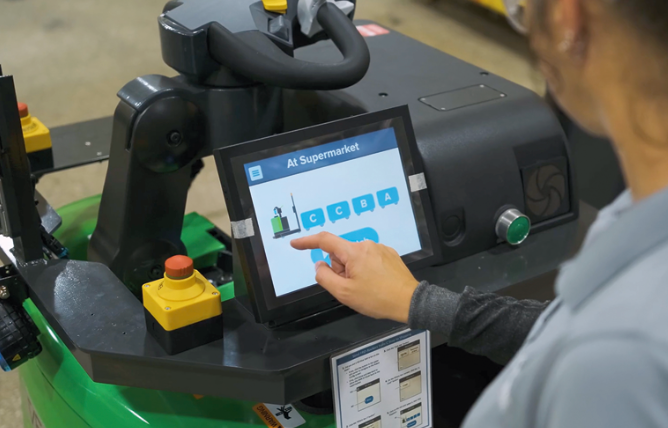
Cell gadgets attach operator, apparatus and tool to create extra environment friendly operations and standardize workflows throughout high-volume, fast moving and threatening paintings environments. This capacity is a huge deal in nowadays’s warehouses as operations proceed to transport towards larger automation and less handbook contact issues.
Using self sufficient elevate vehicles and cellular robots is expanding and converting how we take into consideration cellular gadgets. Those gadgets are regularly constructed into computerized apparatus, bearing in mind much more streamlined operator steerage and coaching.
Not like conventional pills or cellular gadgets that require operators to navigate machine apps and information, those interfaces are designed to easily provide the paintings handy.
“A integrated display interface is purpose-designed for the robotic and tightly built-in with its workflows, which makes it extra intuitive and actionable than a general-purpose cellular tool,” says Zac Dydek, leader era officer, Vecna Robotics. “Slightly than requiring operators to navigate apps or interpret machine information, the robotic’s on-board UI gifts best what’s wanted in that second.”
Operators obtain step by step directions and visible activates, which assist scale back errors and standardize procedure throughout shifts. Vecna Robotics’ usual display presentations updates just like the battery degree, standing of the present challenge, and a repairs menu.
The interface can be used to ship native help data if a robotic will get caught in a scenario the place onsite intervention is needed.
However for plenty of deployments, Dydek notes, the interface presentations one thing so simple as a unmarried “Pass” button that the operator can press to verify a load after which ship the robotic onto its subsequent forestall.
“In additional complex workflows, the display can information customers thru explicit duties, corresponding to pallet pickup directions, showing order or bar code data at select places, and even permitting customers to assign paintings immediately to the robotic by way of deciding on from to be had routines,” Dydek explains.
Since the interface is at all times co-located with the robotic, Dydek says integrated cellular computing eliminates the wish to arrange separate hand-held gadgets and simplifies and standardizes how operators engage with automation.
“As a substitute of depending on separate gadgets or complicated programs, operators engage immediately with the robotic in an excessively task-oriented means,” he says. “In lots of circumstances, that interplay is minimum—urgent a button to advance a workflow—however in others, the display supplies guided directions that scale back coaching time and support consistency.”
In keeping with Dydek, this shifts the operator’s position from manually executing each motion to supervising and participating with the machine.
“The result’s a extra streamlined workflow the place operators can center of attention on value-added duties, whilst the robotic handles the delivery and coordination,” he provides. “Total, the display interface is helping decrease the barrier to adoption by way of making self sufficient cellular robots more straightforward to grasp and engage with in day by day operations.”