Any main generation implementation calls for some point of exchange control, in particular when it comes to independent cellular robots (AMRs) operating aspect via aspect with folks to fortify a facility’s throughput and potency. In GEODIS’ case, the corporate broke down the workflow in its 600,000-square-foot warehouse in Plainfield, Ind., first as an alternative of merely including new generation on most sensible of present processes.
Take incomplete selecting duties, for instance. Previously, when a robotic arrived at a location that didn’t have sufficient stock to finish the choose, it will skip that merchandise. The GEODIS crew then needed to decide what hadn’t been picked, to find the unique activity and free up it again to the ground.
GEODIS labored with a provider (Vecna Robotics) to fully overhaul that procedure. Now, after a robotic skips an merchandise for the second one time and takes the pallet to staging, the machine separates the unpicked product into a brand new activity. The third-party logistics supplier (3PL) can then assign that activity to some other robotic or to an worker who can entire the choose and transfer the order to staging.
That adjust provides warehouse managers a greater solution to establish unfinished duties and free up them when stock turns into to be had. “It made our workflow and our control of that somewhat more straightforward for the management,” says Steve Elsbury, senior operations supervisor. “That workflow is smoother now, and so they don’t have to check out to dig for and to find duties to finish them. It’s a lot more straightforward for them.”
A world 3PL with a regional footprint
With North American headquarters in Brentwood, Tenn., GEODIS handles freight forwarding, contract logistics, distribution, categorical supply and street transportation. Based totally in France, the 3PL operates greater than 1,000 websites, employs about 50,000 folks and serves consumers in 166 nations.
With more or less 118 million sq. toes of warehouse house, GEODIS serves shops and corporations within the shopper items, car, aerospace, healthcare, high-tech and business sectors.
The corporate’s roots succeed in again greater than a century, and as of late GEODIS is wholly owned via SNCF, France’s nationwide railway corporate. It additionally has a visual presence in Center Tennessee, the place it employs greater than 2,000 folks and holds the naming rights to GEODIS Park, the 30,000-seat house of Main League Football membership Nashville SC.
From a football stadium in Nashville, this tale shifts to an overly other roughly operation at GEODIS’ Plainfield, Ind., facility. Devoted to a unmarried puppy merchandise buyer, the power ships clutter containers, puppy toys and identical merchandise to impartial shops and large field retail outlets. About 75% of its quantity strikes thru case selecting, with inner-pack and full-pallet selecting making up the remainder.
That case-picking quantity greater sharply all through the pandemic, when puppy product call for surged and GEODIS went from operating two shifts (with 9 electrical pallet jacks according to shift) to working 3 shifts across the clock. At 100% efficiency, handbook electrical pallet jack (EPJ) selecting may just simplest get a specific amount of quantity in the course of the facility.
“We noticed robot selecting in an effort to get extra throughput in the course of the development,” says Elsbury.
Taking the using out of selecting
GEODIS used to be already the usage of collaborative robots for every selecting, with staff selecting person merchandise for smaller and e-commerce orders. The 3PL had additionally labored with Vecna Robotics on a 2019 point-to-point pallet-shuttling software that moved merchandise inside of its amenities.
Now the 3PL had to follow that have to case selecting. The Plainfield facility used to be the very best atmosphere for a similar human-in-the-loop strategy to a high-volume case-picking operation. There, GEODIS staff had been selecting massive numbers of instances to pallets for cargo via truckload or less-than-truckload (LTL) to shops and different distribution facilities.
“We already knew that we would have liked to do case selecting right here,” says Andy Johnston, senior director of design engineering and innovation, “in order that changed into the following evolution for the usage of collaborative robotics.”
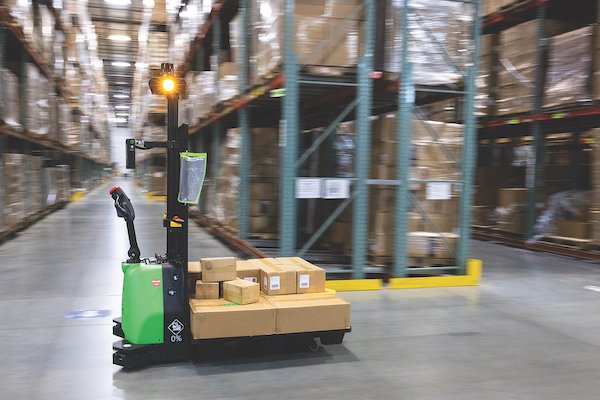
To kick the undertaking off, GEODIS and Vecna collaborated on how the similar independent pallet jack (APJ) used for point-to-point delivery may just shuttle in the course of the aisles whilst an worker picked instances at once to it. Staff would nonetheless deal with the selecting, however the robots would deal with the using and take the finished pallets to staging. That might additionally scale back the quantity of coaching required for brand spanking new staff. With EPJs, staff had to be informed the warehouse control machine, find out how to pressure the apparatus, the power’s choose development and the place to degree finished pallets.
Product staging used to be some other house the place GEODIS wanted lend a hand. Staff had been spending an excessive amount of time at the dock searching for pallets left within the improper places. Now, the robots take finished pallets to their assigned staging spaces and request lend a hand when they may be able to’t get right of entry to one.
“If the Vecna robotic says it’s going to take a pallet to staging location 35, it is going to degree it in that location,” says Elsbury. “And if for some reason why it could actually’t, the robotic will will let you know that it wishes some help to get it to some other location.”
The robots would additionally lend a hand GEODIS deal with extra quantity with fewer shifts and scale back the supervisory protection required for a three-shift operation. They’d make the selecting procedure more straightforward for brand spanking new staff to be informed, getting rid of a lot of the apparatus, pick-path and staging coaching they up to now had to rise up to hurry and paintings successfully.
It used to be a crew elevate
Turnkey programs include glaring benefits.
They’re prebuilt, examined and in a position to place into use. However stepping into at the floor flooring with a producer can produce one thing adapted to a selected operation sooner than it turns into to be had around the seller’s broader buyer base.
That’s precisely what took place right here, beginning when GEODIS approached Vecna about increasing the independent pallet jack past point-to-point delivery and the usage of it for case selecting. Vecna didn’t but be offering that software as an ordinary product, so the 2 firms joined forces and evolved it in combination.
For the preliminary check, Johnston labored with two Vecna staff to create paper choose duties. Operators drove the vans as regardless that they had been independent, whilst Johnston and the Vecna crew finished the selections themselves. They recorded how lengthy every activity took with out the shuttle time required to pressure an EPJ in the course of the facility. The effects gave each firms sufficient proof to stay going.
As soon as the possible build up in items according to hour changed into glaring, the point of interest shifted to the generation and integration had to improve it. “We had been really simulating the machine within the facility to look if it will paintings,” Johnston says. “After we were given the units-per-hour (UPH) effects, we knew that if shall we get the generation and the mixing finished, we’d see an attractive important growth in picker UPH.”
For his or her subsequent act, GEODIS and Vecna checked out how the robots would keep up a correspondence with the warehouse keep an eye on machine (WCS) and, in the long run, the warehouse control machine (WMS).
They outlined what knowledge every activity would come with, the place the robotic had to pass and what it wanted to select. In addition they evolved a formulation for dividing orders into person pallet-level duties (since every robotic handles one pallet at a time).
The 2 firms additionally needed to decide how finished pallets would succeed in the proper staging lanes. Slightly than sending each and every pallet to at least one location for later distribution, the machine directs every robotic to the staging lane assigned to that order. That required hours of calls and website visits to construct the mixing round the best way GEODIS wanted the operation to run.
The outcome used to be an software evolved across the wishes of the Plainfield operation, with the possible to improve identical case-picking programs throughout Vecna’s buyer base.
Making room for the robots
As a pilot website, GEODIS’ Plainfield DC performed the most important function in mapping out precisely how the machine would perform in an energetic success surroundings. Elsbury says a couple of facets of the unique setup had been adjusted in line with enter from the protection crew and the goods shifting in the course of the development.
As an example, the robots couldn’t lengthen previous the racking into the aisles, and the power had to take away end-cap spaces the place staff had staged empty cartons and different discarded fabrics. The crew additionally needed to to find puts for the license-plate placards and tape weapons that pickers use with out blocking off the sensors that information the robots.
Vecna mapped the power via using thru every aisle and staging lane and the Vecna machine didn’t require a separate wi-fi machine for the robots.
“One of the crucial different issues that I preferred about it’s after they did the mapping, they drove up and down the entire aisles and the entire staging lanes one time,” Elsbury explains. “So, there’s no upkeep for us to take care of a separate wi-fi community.
From order free up to ultimate staging
With the power preparation entire, consideration shifted to the order drift. The WMS receives the orders and runs them thru a wave template that sends the paintings to the WCS. Duties are separated via kind, with the ones assigned to the AMRs despatched in the course of the WCS to Vecna’s orchestration engine. The machine assigns every activity to a robotic and determines the order final touch.
Robots start at their house places and shuttle to the induction house, the place an worker attaches the order placard and lots the desired pallet kind (for instance, CHEP, plastic or A-grade pallet). The next day to come’s orders are launched immediately, and Vecna’s tool dispatches the robots to pickers sooner than directing every finished pallet to its assigned staging lane.
“We free up all of the next day to come’s paintings to Vecna and let their orchestration engine do the magic to get the ones selections finished,” Elsbury says.
Pickers use the robotic’s person interface to finish every activity. The display walks them in the course of the choose and offers buttons for exceptions, together with skipped or brief selections. That removes the want to memorize the WMS key purposes staff up to now used whilst using EPJs. “The machine tells them what to do each and every step of the best way,” Elsbury says. “That makes it a lot more straightforward to get staff up to the mark on selecting with the robots.”
Supervisors nonetheless plan the dock sooner than every shift, in particular when handbook and robot-picked pallets proportion the similar staging spaces. They assign the desired handbook and robotic staging lanes sooner than liberating the paintings. From there, the AMRs take every pallet to the positioning specified within the activity.
Tremendous-tuning the reside machine
As soon as the robots had been operating at the flooring, GEODIS discovered its supervisors wanted quicker get right of entry to to work-in-progress information. “After we first went reside, we didn’t have the person dashboards and data availability that we would have liked,” says Johnston. “The whole lot that we had been getting used to be 24 hours outdated.”
Supervisors and activity managers wanted real-time visibility after they launched orders to the robot selecting machine. They needed to know what used to be going down at the flooring, together with what were picked, what remained and the way the operation used to be progressing towards the day’s plan.
The reporting features had been there, however GEODIS wanted the guidelines quicker. The usage of comments from Johnston and the operations crew, Vecna advanced the dashboards, which now supply real-time perspectives of robotic places, order standing and day by day growth.
The machine additionally tracks productiveness on the crew and person ranges, giving managers the knowledge they want for efficiency bonuses and training. “That is essential knowledge for the operations crew to have in genuine time to regulate the workflow of the power,” says Johnston. “The reporting used to be a problem in the beginning, however the dashboard has since grow to be an overly great tool.”
Doubling throughput and bettering protection
With the brand new resolution in position, productiveness greater round 85% on reasonable with sure days reaching a 150% efficiency growth.
“We’re selecting two times up to we did on handbook EPJs,” Elsbury says. New pickers operating with the robots in most cases get started at a efficiency point 200%, when put next with the former setup. Their coaching begins with the robotic machine itself, as opposed to requiring staff to first learn to pressure the apparatus, navigate the power and use the WMS interface.
The added throughput allowed GEODIS to drop go into reverse to 2 day by day shifts and scale back the common choice of day by day pickers. The corporate gave staff new alternatives in different spaces of the Indianapolis campus or close by GEODIS amenities.
Protection features rounded out the consequences. Incidents involving powered business apparatus dropped from seven in 2022 to only two over the next 24 months. “At the side of the whole thing else, the brand new setup greater the protection of our teammates at the flooring,” Elsbury says. “That’s vital to us.”
Having a look forward, Johnston says GEODIS will proceed the usage of automation to extend throughput, ease exertions constraints and make jobs more straightforward for workers.
“Numerous what we’re doing presently revolves round AI,” he says. “How can we use this software that’s evolving at breakneck pace to fortify our operations and make the generation even higher? I believe the ones are the fascinating issues to return, particularly for our trade.”