There’s an issue to be made that pick- and put-to-light had been round for many years, and are due to this fact a bit of mundane, a bit of conventional.
In an international stuffed with thrilling robotics and complex instrument, that argument isn’t utterly mistaken. However whilst it sort of feels that everybody has been there and performed that with pick-to-light and put-to-light, it nonetheless has a treasured position to play. And the era has developed—and continues to—despite the fact that now not on the identical warp velocity as AI and robotics.
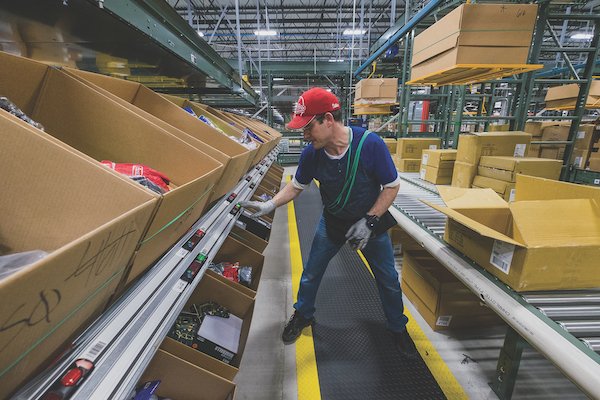
There’s this, too: Choosing stays one of the crucial labor-intensive jobs within the warehouse. Because the exertions scarcity continues and, in some puts, grows, discovering era answers is the secret. For a reasonably low cost resolution, pick-to-light and put-to-light can ship a just right go back on funding. The era stays efficient and crucial for serving to operators successfully and correctly decide smaller pieces at a quick charge.
Dick’s Carrying Items is a superb instance. A 650,000-square-foot distribution middle—probably the most corporate’s 5 such amenities—in upstate New York feeds as much as 160 of the carrying items retail outlets. An omni-channel store, the corporate counts on velocity and versatility to provider its shoppers. It is dependent upon end-to-end automation to transport its vary of stock towards their quite a lot of locations.
If going to probably the most loads of retail outlets, the goods transfer to damage packing, high quality assurance, semi-bulk or cross-docking. On the break-packing level, pickers use fashionable put-to-light programs from Toyota Computerized Logistics to organize orders for particular person retail outlets. Whilst an AutoStore is the main decide and garage engine, put-to-light put partitions function an integral cog within the general glide of the ability.
“Operationally, pick-to-light hasn’t modified all that a lot over time,” says Thomas Sperstad, Lighting fixtures Pick out account supervisor for Pyramid. “But it surely’s a low cost, efficient gadget, particularly for guide selecting operations.”
The place it has developed
Conventional and same old would possibly describe those light-directed answers, however that doesn’t imply they’ve remained unchanged or unimproved. There are a number of tactics during which the era has developed for the easier and warehousing advantages from it.
Chris Bratten, senior supervisor of instrument consulting at Toyota Computerized Logistics (previously Bastian Answers), says that one advance is the appearance of self-contained gadgets, which make pick-to-light extra versatile.
Those fashionable programs simplify the set up procedure, making them extra of a plug-and-play arrange. This design cuts down at the prices of set up and makes it a quicker procedure.
“This permits customers to undertake to modify briefly and simply,” says Bratten. “Say you’re the use of 8 places on a shelf, and you want to re-slot that shelf to come up with 12 places. With a self-contained instrument, it’s more uncomplicated to transport issues round and meet your wishes as they alter.”
Different benefits to this setup come with decrease up-front prices as a result of they get rid of the desire for specialised exterior controllers PCs and scale back your {hardware} investments on the outset. Moreover, some answers can keep in touch at once along with your warehouse control gadget (WMS) or programmable good judgment controller (PLC), the use of same old instrument.
“You plug in its keep watch over field, and the instrument sends the sunshine instructions, which the pickers then ascertain,” says Bratten.
He provides that Toyota Computerized Logistics is seeing the recognition of those self-contained programs within the kitting area. “We see operations with a small selection of places according to kitting station, most often between 10 and 15,” he explains. “You scan an element quantity or a invoice of fabrics, and the gadget tells you what to pick out and put right into a package.”
Pick out-to-light and put-to-light programs that experience long gone wi-fi and battery unfastened are some other pattern, in line with Ed Romaine, vp of promoting and industry construction at Built-in Techniques Design.
“They obtain their energy from an RFID sign slightly than having to make use of on-board batteries,” Romaine says. “While you had a twine to the programs, it generally is a ache if somebody knocked it offline. This has been an actual step ahead.”
Those wi-fi programs be offering real-time visibility, when paired with the WMS, and another way function with the similar options that make pick-to-light this kind of tried-and-true era. Something to remember is that wi-fi doesn’t essentially imply cheaper price. They are able to convey with them the prices of wi-fi protection and interface, instrument sturdiness and battery control.
Romaine additionally sees a pattern of AI and IoT being layered onto pick-to-light. “This permits organizations and sensors to gather real-time knowledge at the selecting procedure,” he says. “The algorithms are increasingly more predicting your call for and optimizing your settings.”
The result’s that operations can higher use staff in response to predicted volumes in quite a lot of zones. Whilst now not but embedded within the apparatus, customers can layer AI on. That is the place a just right integrator comes into the image to lend a hand with the method. “AI can see what you’ve performed previously and are expecting in response to the accumulated knowledge,” Romaine says. “You’ll be able to velocity issues up and building up throughput.”
AI could also be taking part in a task in symbol reputation, says Douglas Card, director of key accounts and integrator gross sales at Kardex Remstar. “We’re seeing some new era round camera-based and projector-based programs,” he says. “As a substitute of lighting, you’ve a digital camera that may light up the place to pick out.”
Whilst in its early iteration, this AI-enhanced symbol seize would possibly constitute the way forward for pick-to-light. “It’s much less error vulnerable and gives extra comments and validation to the person,” says Card.
At Modex previous this yr, Kardex Remstar presented its Intuitive Choosing Help (IPA) designed to lift the selecting processes operated by way of AutoStore programs. “It guides the picker throughout the procedure,” Card explains.
The gadget brings the goods and/or packing containers to the operator and lighting up the pieces to pick out, spotting the operator’s palms as they take away the article. If the picker makes an error, the gadget indicators them to it, expanding selecting accuracy by way of taking into account error correction. Operations can customise the interfaces to person personal tastes or warehouse wishes.
Every other pattern is color-based selecting, which additionally lends itself to extra flexibility at a cheaper price, in line with Card. “If in case you have peaks and valleys, you’ll scale with a color-based gadget,” he says. “While you’re off top, you’ll put handiest a few folks at the coloration gadget, and flex up all over busy gadget, all with no need to take a position closely in automation.”
Significance of integration
The opposite tale in pick-to-light and put-to-light is their integration into totally automatic operations. “You’re seeing a lot much less stand-alone and extra hybrid programs,” says Sperstad. “For instance, when you’ve were given an upstream batch decide to a cellular cart, you’ll convey them right down to a put wall to kind for e-commerce,” he says.
There’s additionally much more inclusion of robotics, AutoStore programs and vertical carry modules (VLM) along pick-to-light. The most important case for those hybrid programs, stated Sperstad, is the emerging selection of SKUs and on-line ordering.
“It’s important to automate extra to perform extra with the exertions you’ve,” he says. “While you mix programs, you’ll building up throughput by way of two to a few instances. Ten years in the past, we couldn’t have imagined the place we’re lately.”
Pyramid’s Lightning Pick out integrates with various apparatus and comprises multi-floor distribution and multi-modal {hardware} ecosystems. It allows operators to orchestrate selecting throughout more than one flooring, all whilst the use of an interface to the WMS or undertaking useful resource making plans (ERP) gadget. The usage of zone selecting good judgment, the gadget sends totes or orders between flooring on conveyors or VLMs. This permits customers to mix more than one methodologies.
“We’ve moved on from an both/or state of affairs to an ‘and’ gadget in relation to pick-to-light,” says Sperstad.
Gentle-directed answers, then, will have to be thought to be a “device within the toolbox,” says Bratten. “We see a lot of operations the place you’ll have an AutoStore and a goods-to-person gadget, after which a decide module for heavier pieces,” he says. “Lighting fixtures can nonetheless be an integral a part of an general resolution.”
As a result of now not all warehouses can automate end-to-end, pick-to-light additionally too can spice up productiveness at a cheaper price. Those are the extra guide amenities which are merely in search of a option to strengthen what their employees can do in an afternoon.
“A easy amount show can paintings smartly in those amenities, particularly if their exertions drive has multi-lingual wishes,” says Bratten. “They are able to see an growth in only a day.”
It is probably not flashy, and may well be reasonably commoditized, however pick-to-light nonetheless performs a key position within the warehouse. It’s a sound choice for firms who wish to leverage their selecting with out the massive funding.
“Step one in automation is continuously pick-to-light,” says Bratten. “There’s handiest such a lot you’ll do with it, however there’ll proceed to be just right packages for pick-to-light and put-to-light someday.”