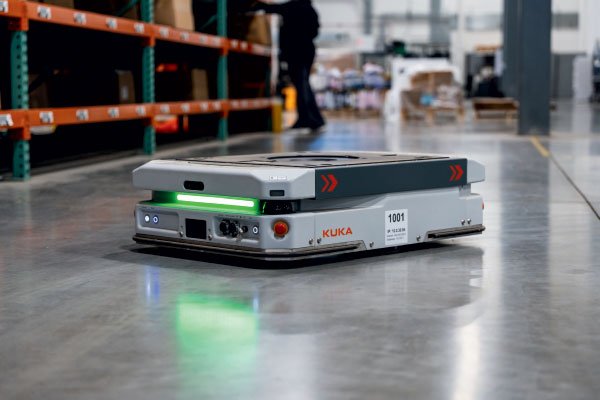
Warehouse operators aren’t simply purchasing robots anymore. They’re asking how the ones machines have compatibility, be in contact and stay product shifting in their amenities. And whilst the {hardware} continues to be vital, the larger center of attention is on how tool, integration issues, fleet control equipment, sensors and requirements all paintings in conjunction with the robots in busy achievement environments.
As extra firms upload automation in layers, for instance, cell robots must be in contact with warehouse control techniques (WMS), warehouse execution techniques (WES), order control techniques (OMS), conveyors, elevate vans and different robot techniques, all with out turning the operation into a posh science challenge.
Put merely, the robotic nonetheless has to transport the product. However now operators even have to invite what it connects to, what it talks to and what sort of paintings it creates as soon as it’s at the ground.
“You’ll put the {hardware} in,” says Brendon Turner, account supervisor, AMR, at Kuka, “however I all the time inform other people, in the event you’re prepared to spend money on automation, why don’t you do it from finish to finish?”
Listed here are six traits pushing cell robots past stand-alone apparatus and into higher roles at the DC or warehouse ground.
1) Instrument takes on extra of the paintings. Cellular robots were given a lot of consideration at the Modex display ground in Atlanta this 12 months, however in logistics and warehousing, Turner says extra of the dialog now facilities at the tool that drives their paintings. In lots of amenities, that implies connecting the fleet supervisor to the techniques already dealing with orders, stock and achievement selections.
In a warehouse environment, the fleet supervisor prioritizes the place robots move and what they do. It will probably additionally hook up with every other tool layer, reminiscent of an order control device (OMS), warehouse control device (WMS) or warehouse execution device (WES), which handles order processing and era prior to sending paintings to the fleet.
With many firms already working on endeavor useful resource making plans (ERP) platforms from Oracle or SAP, Turner says the objective is to attach the ones techniques at once to the robotic fleet.
That manner, orders can transfer from the industry device into the warehouse workflow with out including additional handoffs or asking workers to control selections the tool can already make.
Turner says Kuka works with Numina Workforce, whose Actual-time Distribution Machine (RDS) brings orders in, batches them and sends that knowledge to the robotic fleet to hold out the paintings. “Orders are available from the [OMS or WMS],” says Turner, “and are then dispatched at once to the robots to control the logistics procedure within the warehouse.”
2) Cellular robots transfer inside of attain. There used to be a time when cell robots have been both out of attain for plenty of firms or handled extra like a novelty than an actual warehouse instrument. That’s converting as extra firms search for techniques they are able to convey into present operations, particularly in spaces the place conventional automation prices an excessive amount of, takes too lengthy or simply doesn’t have compatibility the paintings.
Kim Karvonen, vice chairman of gross sales at Piaggio Rapid Ahead, says firms need era that’s more straightforward to convey into the warehouse and get started the use of instantly. “There’s a development towards much less complexity,” he says, “and a push towards era that may be extra simply followed to operations.”
This can be a win for amenities that might not be able for full-stack automation, however that also want lend a hand automating some handbook processes. Karvonen issues to selecting operations with prime SKU counts and coffee select volumes as one instance. Non-conveyable items and e-commerce choosing can fall into the similar class, the place the paintings will also be not easy to automate the use of fastened techniques.
Karvonen says that even amongst firms that use automation, one of the vital paintings won’t have compatibility well into a set device. It may well be the product itself, the order profile or the way in which the method runs. Regardless of the root reason, cell robots can lend a hand fill in and automate the ones hard-to-reach workflows.
3) The industry case will get extra consideration. Consistent with Michael Harris, vice chairman of Ocado Cellular Robotic Techniques at Ocado Clever Automation, many shoppers now come into early conversations with a greater sense of the kind of device they would like.
From there, the questions get extra explicit: How will the device carry out? How briskly will it pay again? Can the supplier turn out it prior to the challenge is going reside?
Corporations also are assessing cell robots in opposition to a harder running backdrop. Hard work charges, gas prices and price lists are all pushing up the associated fee to serve, whilst consumers nonetheless be expecting sooner supply, dependable timelines and correct orders. That places extra drive on warehouse automation to provide measurable effects.
“We’re unquestionably seeing that businesses are requiring sooner and sooner paybacks,” Harris says. “In addition they need assurance that they’ve invested in one thing that can keep growing with them as their industry adjustments over the following couple of years.”
That’s the place simulation, knowledge and analytics are available. Harris says Ocado makes use of the client’s personal knowledge to lend a hand show how a device will carry out and what returns it will probably ship. This shifts the purchasing dialog for warehouse and DC operators. The robotic nonetheless has to do the paintings at the ground, however firms need the industry case examined prior to the challenge begins.
4) Carry vans are a part of the robotic dialog. Cellular robots aren’t restricted to small carts, each-picking or goods-to-person workflows. They’re additionally shifting into elevate truck programs, the place firms are taking a look at how pallets transfer around the facility and whether or not the automatic model of that transfer will have to glance the similar because the handbook one.
A facility the use of counterbalanced vans or pallet riders lately would possibly want to ask a special set of questions as soon as automation enters the image. What wishes to transport? How some distance does it go back and forth? How frequently does the apparatus go back empty? May a special computerized automobile transfer extra product with fewer wasted journeys?
That’s the place the use case issues, says Kyle Sensible, gross sales supervisor, robotics automation at Yale Carry Truck Applied sciences. A tow tractor with carts or trailers, for instance, would possibly transfer extra product immediately and cut back empty fork go back and forth on go back journeys. That may exchange how an organization thinks concerning the transfer itself, no longer simply the elevate truck it makes use of lately.
For warehouses and DCs, it’s much less about swapping one elevate truck for an automatic model and extra about matching the automobile to the paintings. “In the event that they’re the use of forks to transport pallets throughout amenities and lengthy distances, do they want to use a forks-automated resolution to try this going ahead?” Sensible says. “It’s no longer only a easy, ‘I exploit this taste truck lately, and after I automate, it must be that very same taste truck.’”
5) AI is helping robots learn the room. Synthetic intelligence (AI) has been operating its manner into just about each nook of the warehouse, and cell robots aren’t any exception. Distributors are interested in making robots higher on the paintings they already do, from navigation to how the gadgets transfer round every single different in busy amenities.
Karvonen says AI used to be probably the most larger traits on show at Modex this 12 months. “AI goes to make automation extra able to predicting and adapting to eventualities which were sticking issues up to now,” he says.
In cell robotic programs, that might imply higher navigation, higher orchestration and higher motion between gadgets as they go back and forth throughout the facility. Karvonen says AI too can strengthen collaborative options, together with human following and contactless pushing, by means of making the ones purposes extra predictive.
That issues as a result of some environments can’t be absolutely computerized, and sure workflows nonetheless require human judgment or dealing with. Karvonen expects to look extra applied sciences constructed for the ones eventualities, the place other people stay a part of the paintings.
“We’re going to look a era of applied sciences and robot answers,” Karvonen provides, “that can particularly cope with environments the place the human must be a part of the method.”
6) Blended fleets want a referee. As soon as firms get started making an investment in cell robots, they don’t all the time prevent with one kind, one logo or one use case. That’s the place VDA 5050 is available in.
The open conversation usual originated in Europe and is gaining consideration as firms search for a not unusual strategy to attach cell robots from other producers to a central fleet supervisor.
Turner says connecting cell robots made by means of other producers is changing into extra vital as firms assume past their first cell robotic deployment.
“I believe that [interconnectivity] is coming beautiful briefly,” Turner says. “Corporations had been the use of self reliant fabrics dealing with applied sciences, however now they’re asking, ‘If I convey every other corporate in, how will those techniques paintings in combination?’”
Turner issues to 1 massive OEM that had greater than 9 manufacturers of fabrics dealing with apparatus in its amenities at one time. 5 years in the past, he says, interoperability wasn’t a lot of a dialog. Now, firms like that one are occupied with it previous as a result of they know their fleets would possibly develop in numerous instructions.
“They’re making plans for the long run,” says Turner. “They know they’ll want multiple form of automobile, and interoperability provides them a strategy to set up the ones techniques in combination.”