Production output remained at the proper aspect of expansion in October, in step with the brand new version of the Production File on Industry, which was once issued lately via the Institute of Provide Control (ISM).
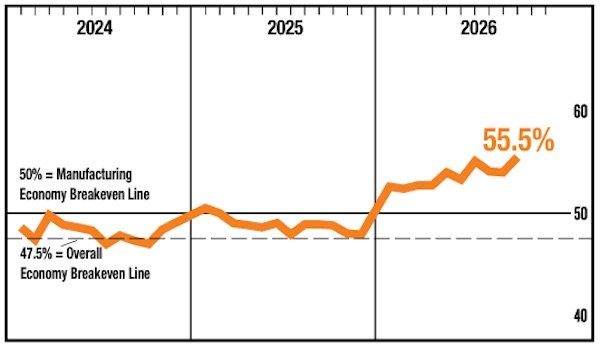
The record’s benchmark studying, the PMI, at 55.5 (a studying of fifty or above signifies expansion), posted a 1.0% achieve over September, which eked out a nil.1% achieve over August, with October rising, at a sooner tempo, for the tenth consecutive month. The October PMI is 0.1% underneath July’s 55.6, which marked the absolute best per 30 days tally going again to Might 2022’s 55.9. ISM additionally famous that the full financial system grew in September, for the twenty fourth annual month.
The October PMI studying was once 2.7% above the 12-month reasonable of 52.8, with July’s 55.6 marking the absolute best and December’s 47.9 marking the bottom over that length.
ISM reported that 12 production sectors expanded in September (down from 15 in August): Plastics & Rubber Merchandise; Electric Apparatus, Home equipment & Elements; Equipment; Laptop & Digital Merchandise; Textile Turbines; Number one Metals; Transportation Apparatus; Fabricated Steel Merchandise; Furnishings & Similar Merchandise; Chemical Merchandise; Miscellaneous Production; and Meals, Beverage & Tobacco Merchandise. Sectors seeing contraction have been: Printing & Similar Fortify Actions; Paper Merchandise; and Nonmetallic Mineral Merchandise.
ISM cited the next key metrics for October:
- New Orders: 55.5, up 0.2%, rising, at a sooner tempo for the tenth consecutive month, with 11 sectors reporting expansion;
- Manufacturing: 59.0, up 2.3%, rising, at a sooner price, for the twelfth consecutive month, with 11 sectors reporting expansion, coming in at its absolute best degree since November 2021’s 60.5 studying;
- Employment: 52.4, down 0.3%, rising, at a slower price, for the fourth consecutive month, following 32 months of contraction, with 8 sectors reporting expansion
- Provider Deliveries: 59.1 (readings above 50 point out slower deliveries), up 0.1% in comparison to September, slowing, at a sooner price, for the eleventh consecutive month, with 12 sectors reporting slower deliveries;
- Inventories: 51.4, up 2.0%, rising, after contracting in October, which was once preceded via 3 months of expansion, with seven sectors reporting upper inventories;
- Shoppers’ Inventories: 41.6, flat sequentially, final too low on the identical price for the twenty fifth consecutive month, with 0 sectors reporting upper inventories and 11 sectors reporting upper inventories;
- Costs: 75.2, down 2.7%, expanding, at a slower price, for the twenty fifth consecutive month, with 16 sectors reporting upper costs; and
- Backlog of Orders, at 54.6, rising, at a slower price, for the tenth consecutive month, with 11 sectors reporting upper backlogs
Financial prerequisites, price lists, and the continuing Iran war have been a number of the major subject matters cited in panelists’ feedback.
“Destructive, inflation, within the purple’ are the 3 phrases or words that highest describe our strategic sourcing for 2026,” mentioned a Chemical Merchandise panelist. “We most often think inflation at 2 % to three % yr over yr, and we most often do a really perfect task preserving prices underneath the 2-percent building up. This yr, prices are up greater than 6 %, and we aren’t doing a lot to stay any of the spend classes underneath the objective. Of the tracked pieces, most effective 9 are decrease, 24 are upper and 6 are impartial. The purple is a little traumatic. Regardless of the price pressures, gross sales had been OK. It gained’t be a really perfect yr. It is exhausting to get occupied with OK or simply getting via. U.S. financial coverage has suffered any other yr, making it unimaginable to make sound long-term selections.”
And a Miscellaneous Production panelist seen that any commodity ate up via AI/information facilities is in a crunch, each for provide and pricing.
“We stay questioning when the insanity will forestall,” mentioned the panelist. “Despite those demanding situations, our call for stays sturdy and the provision chain is getting via, albeit with numerous paintings. As we plan subsequent yr’s price range, it’s sobering to roll up the annualized affect of (1) final price lists, (2) AI-impacted commodity value will increase and (3) value will increase associated with geopolitically influenced commodities.”
In an interview with LM, Susan Spence, Chair of ISM’s Production Industry Survey Committee, famous that whilst considerations stay, the record’s numbers have been forged.
“Manufacturing hit its absolute best degree in 5 years, which is excellent, however pushed via lead-time problems, and costs stay very prime, despite the fact that the studying confirmed growth,” mentioned Spence. “It’s particularly hurtful when a few of these industries see industry coming again they usually can’t satisfy it. Backlog did drop a little however it isn’t transparent if this is because of process from such a lot of other sectors, which is what makes it a excellent pattern. In case you see roughly a choked-up provide chain sitting within the factories with prime inventories however now not numerous manufacturing, it may well be as a result of they’re lacking key elements—however possibly you’ll begin to see it [progress] within the AI-heavy industries.”
With the midterm elections the next day, a lot of what stand as financial considerations—within the type of prime gas and costs, price lists, and inflation, amongst others—stay intact, with value volatility lowering call for in some sectors, with Spence noting in a prior interview that these items underline the affect of the continuing Iran struggle in addition to renewed tariff threats.
To that finish, she defined that amid fluctuating indicators, the ones elements make it tough to really feel higher, or extra assured, concerning the state of producing, regardless of the sturdy October PMI studying.
“With enlargement going down, it stays a excellent tale general, however you can’t forget about the prime costs,” mentioned Spence. “Does the employment dip imply anything else? It does now not appear to be a significant fear, with the sentiment on hiring as opposed to now not hiring advanced a little in October, with the panelist ratio of hiring-to-firing at 1.80-to-1.”
What’s extra, different elements that experience the possible to affect issues now and into the long run are the continuing Iran war, the timing of the AI buildout, and industry coverage.